 Retail experience · Virgin Atlantic · 2024–2025
Making retail
stores findable
Virgin Holidays retail stores generate 5x the average order value of the online e-comm site, yet foot traffic was in decline. I used GA4, Google Search Console, and created a custom GPT to reframe a revenue problem as a discoverability problem, then designed a store finder and appointment booking flow that launched into peak holiday season.
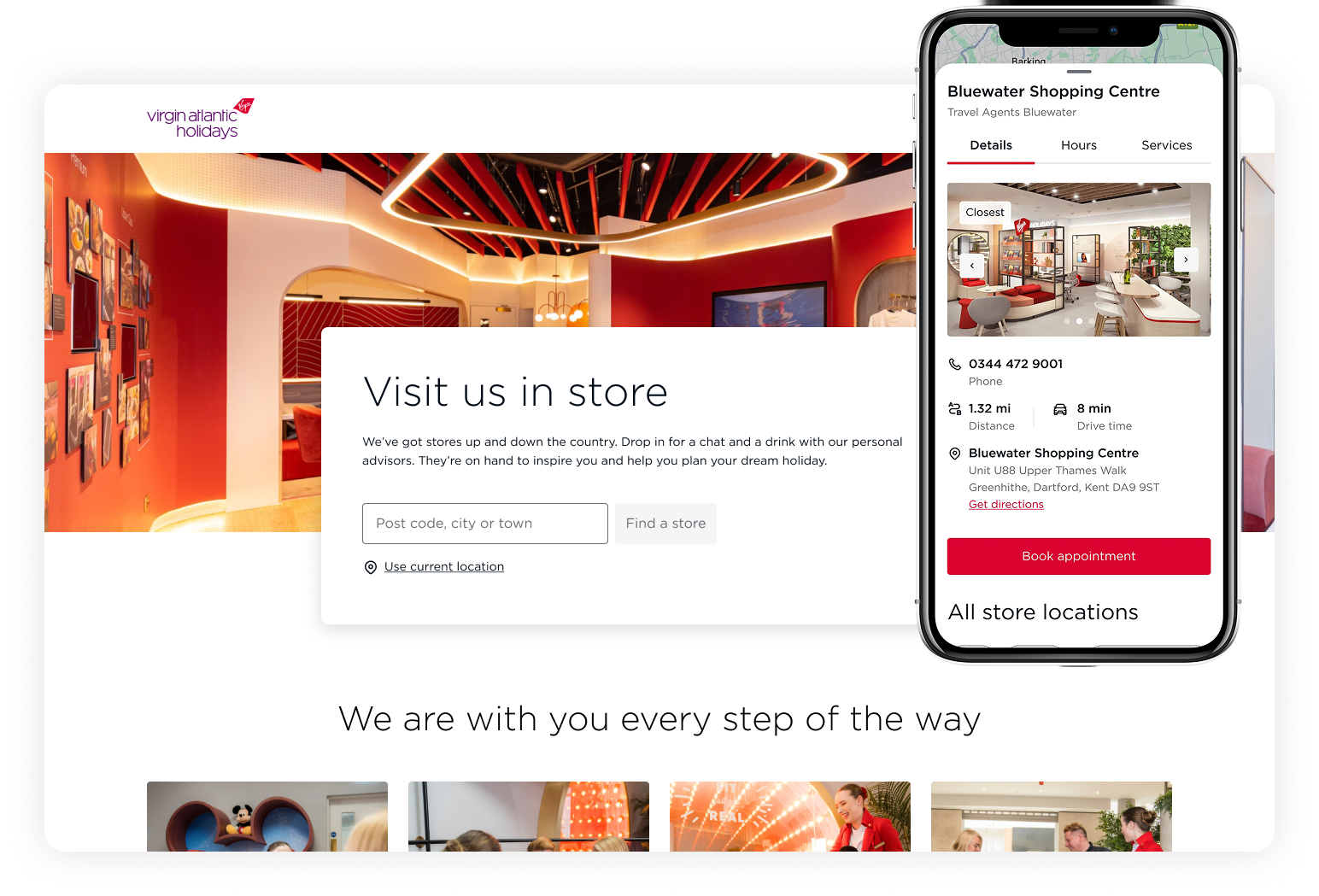
A revenue decline hiding a discoverability problem
Virgin Holidays retail stores were averaging a 20% year-on-year revenue decline. Some locations were down as much as 40%. On the surface this looked like a service or market problem, but the 5x AOV figure told a different story. Customers who visited stores were converting and spending significantly more than those who purchased online, so the stores were highly successful at converting appointments & visits to sales. So why the decline?
"The variance told me everything. Some stores were down 40% while others were up nearly 40%. That is not a service failure, it is a discoverability and awareness problem."
Online marketing channels had grown year on year, drawing search intent toward the online e-commerce funnel. Retail stores, despite their high conversion rate and AOV, had no meaningful digital presence to intercept customers earlier in their journey.
ResearchCross-referencing signals with a custom GPT
I ran a kick-off with the Head of Retail, two regional store managers, lead front and back-end developers, and my product owner. Research spanned two quantitative data channels and an extensive qualitative programme.
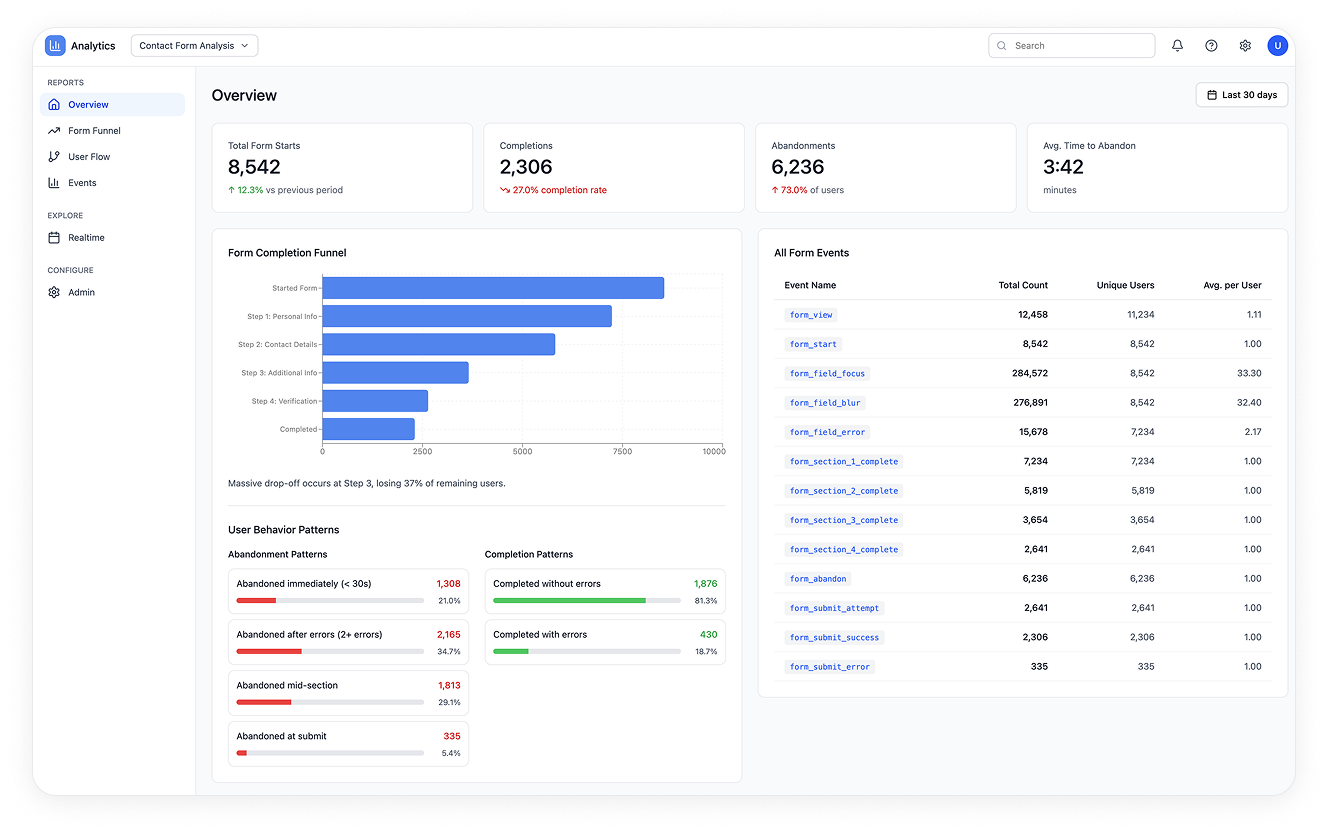
GA4 showed where users were dropping off on existing store-related pages. Google Search Console revealed meaningful organic search volume for store and travel agent queries that the site was not capturing. I built a custom GPT, fed both data channels into it, then cross-referenced those signals against transcripts from 20 staff interviews conducted in-store as contextual inquiry and via video calls and surveys. I visualised the findings in a Figma dashboard for stakeholder alignment.
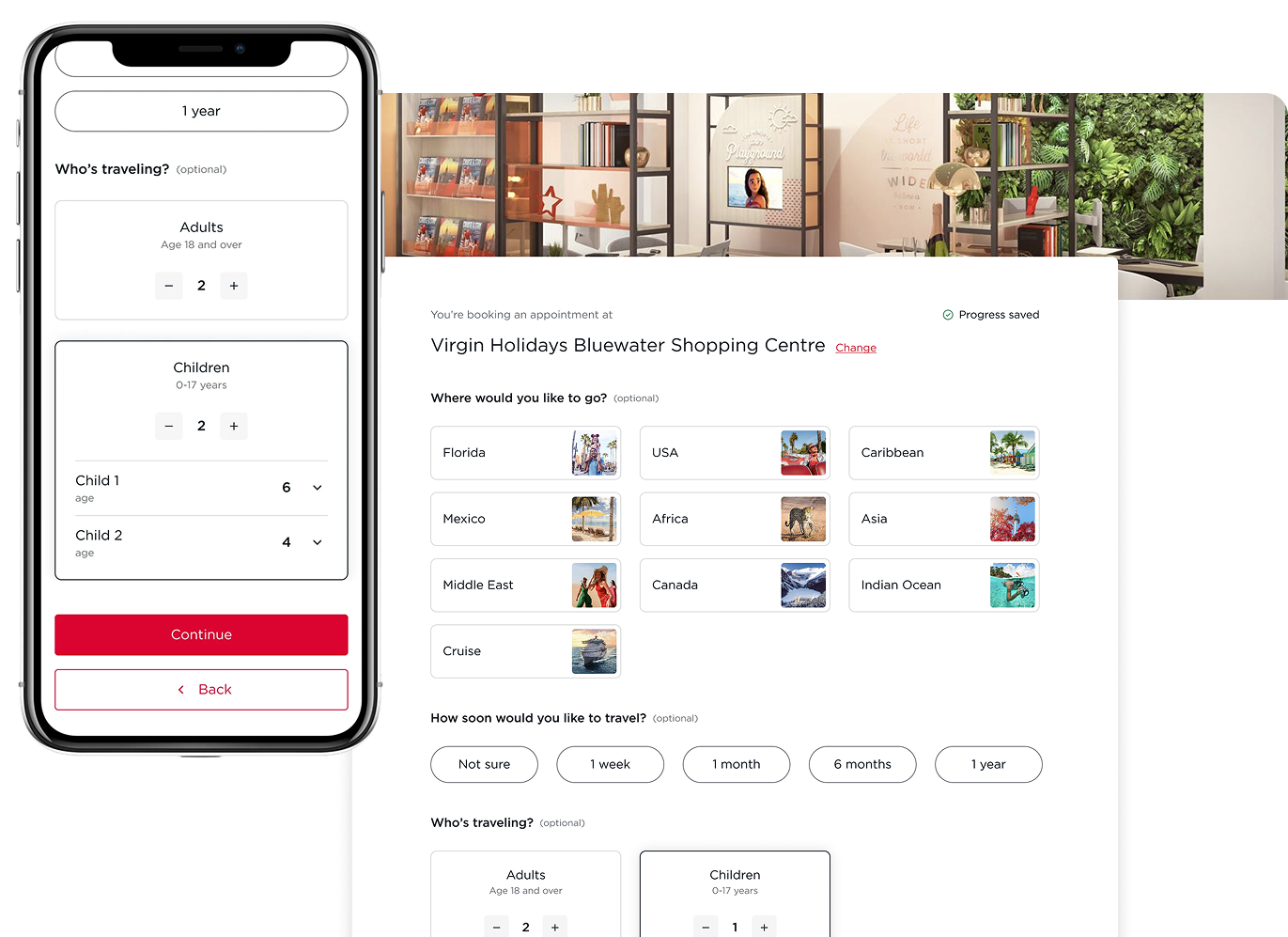
Four assumptions to design and test against
By showing online customers the unique value that online stores provide they should be curious enough to discover stores and book an appointment.
By surfacing stores as an option to customers who failed to convert online, we could keep them in the funnel rather than losing them entirely.
Giving advisors optional holiday intent data before appointments would allow them to deliver more personalised in-store experiences and increase conversion.
A playful, immersive appointment booking form with simple affordances and destination imagery would increase form completion rate.
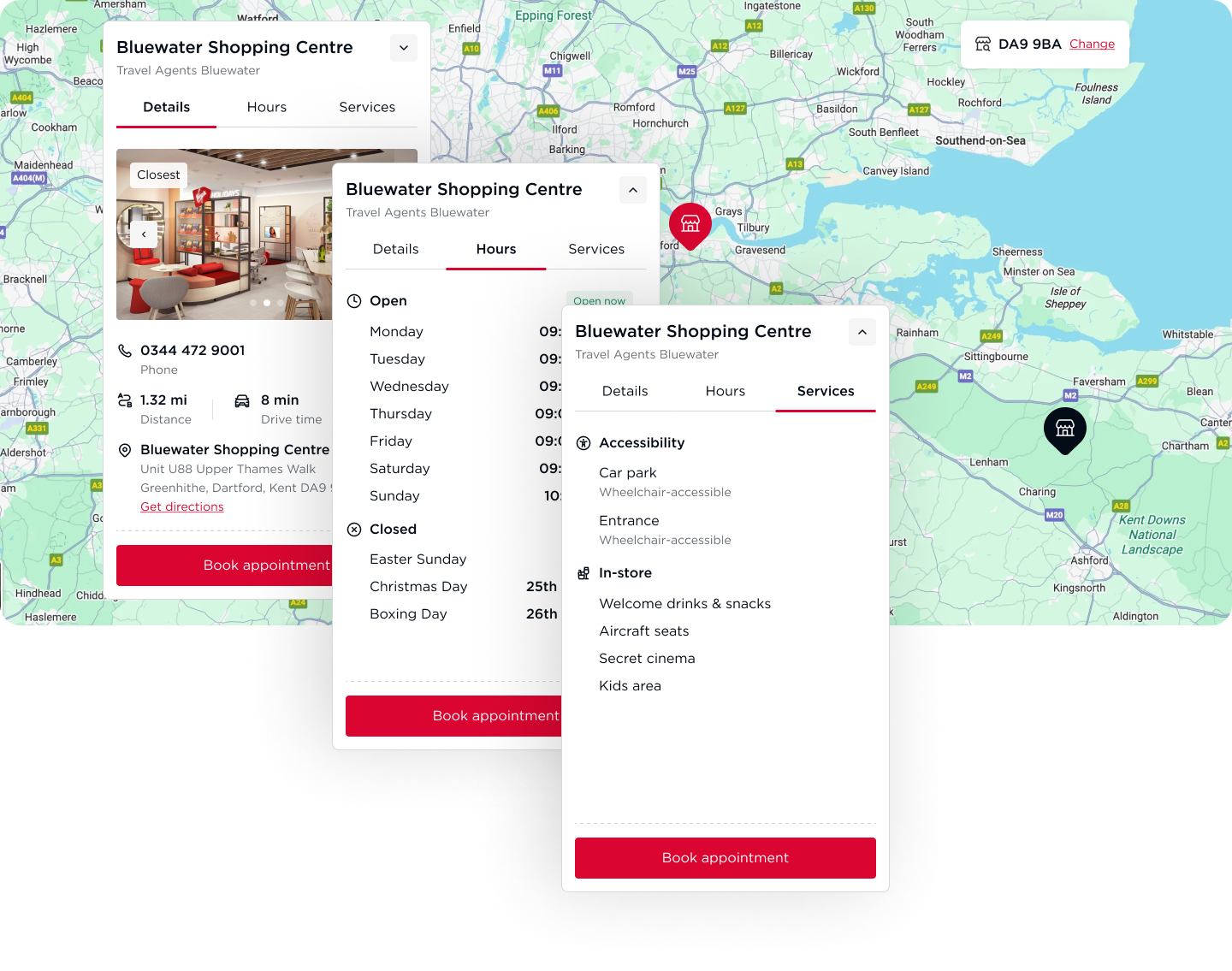
A map overlay that encouraged exploration
I used the existing Google Maps integration as a base and worked closely with the lead front-end developer on technical feasibility. By creating an overlay on top of the map, user interactions, selecting stores, switching tabs, viewing distance, linked directly to actions on a detail card above it.
In usability testing, something unexpected happened: participants began exploring stores they had not originally searched for. They discovered alternative locations closer to where they worked, stores with specific facilities, and routes that felt shorter than the map suggested. The design had created an unintended but valuable discovery layer.
"Participants were consistently surprised that drive time to nearby stores was shorter than it looked on the map. That opened up store options they had dismissed at first glance, exploration we had not explicitly designed for."
The booking form was intentionally playful, with destination imagery, simple stepper inputs, and optional pre-visit fields that let customers share holiday intent without it feeling like a form. This data fed directly to advisors ahead of each appointment, enabling a more personalised in-store experience from the moment the customer arrived.
A key insight from non-linear prototype testing: users instinctively tried to change their selected store after reaching the confirmation screen. That told me a store-change option needed to appear much earlier in the flow. That change made it into the build and is one reason appointment completion rate is trending positively.
Ai Stack to reduce developer handoff
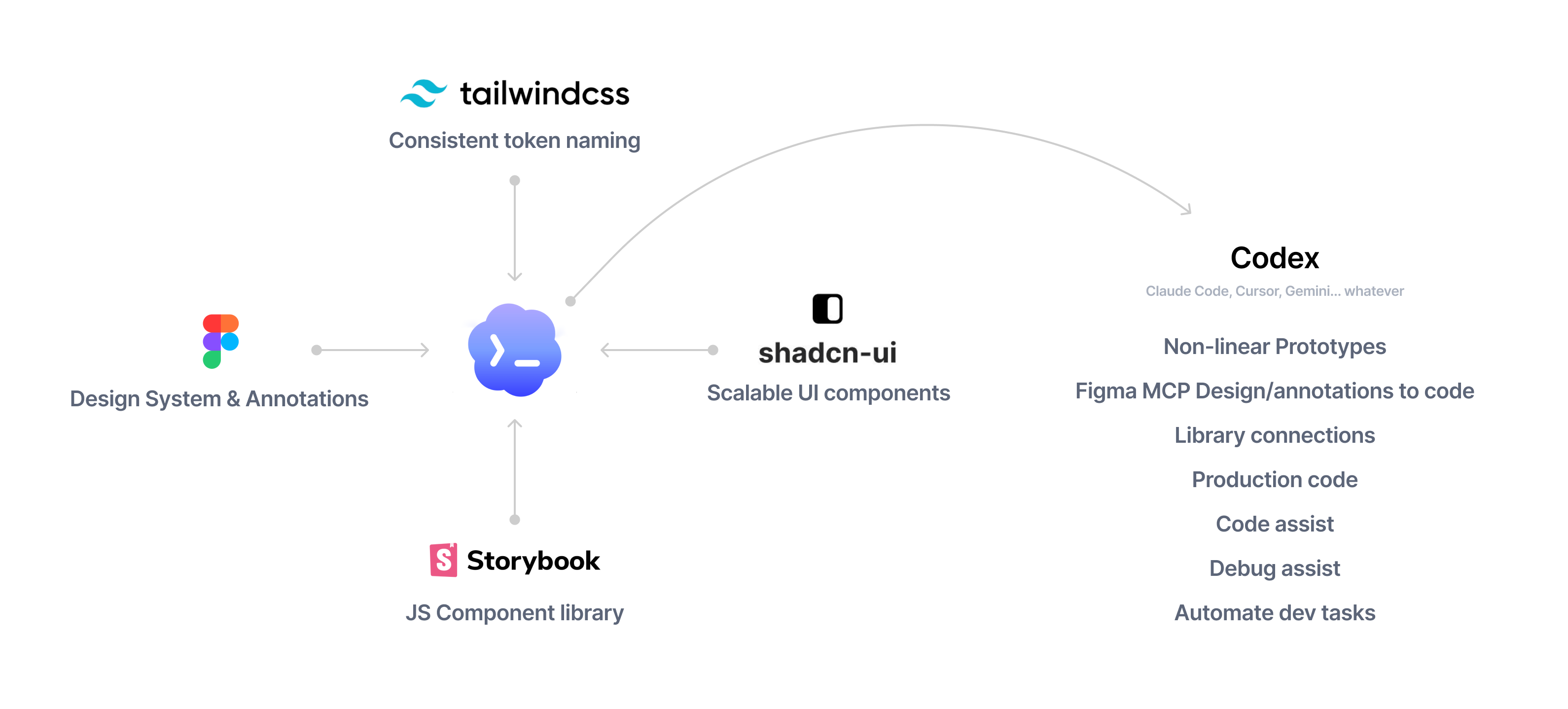
I created the prototype straight into code via Figma MCP and Codex. I allowed Codex to read and understand my Design System and annotations via the Figma MCP. I then had Tailwind audit and create a more consistent naming convention for my Symantic Variable Tokens. I used storybook as a workshop to store and test my components while Shadcn helped create some complex components such as responsive tables and media players.
This allowed me to go from design to code on a test server as I built out a robust prototype for the product usability studies and a POC.
Launched directly into a high booking season
The design went live in April 2026, the peak booking window for end-of-year holidays, when the majority of customers make their holiday decisions after the Christmas and New Year break.
I'm in the process of building the full analytic segments and funnels, tracking appointment completion rate, appointment to visit rate, and whether the optional pre-visit fields correlate with higher in-store conversion. The 65% appointment to sale baseline established before launch is the number being measured against.
Early data shows a 250% increase in store appointments booked with a +10% increase in conversion rate.
Usability testing confirmed the map overlay prompted users to explore stores beyond their original search, an emergent discovery layer that strengthened the business case.
A mid-project re-org removed the BA from the team. Rather than let that become a blocker, I took ownership of data gathering, building the custom GPT and Figma dashboard independently.
Launching in April, a high booking window, maximised the impact of the new store finder at exactly the moment of highest customer intent.
What I would do differently
One thing I would change is getting analytics instrumentation aligned with engineering before design started rather than alongside it. That would have compressed the time between launch and first insight considerably.
What the re-org reinforced is something I now hold as a principle: in modern product teams, design and analytics cannot operate in separate lanes. Taking ownership of the data rather than waiting for resource was the right call, and it is a pattern I bring to every project.
Want to chat more about this project?
I am happy to walk through the custom GPT methodology, the Figma prototype architecture, the stakeholder alignment process, or the full funnel analysis as it develops.
Send me an invite to chat